

What is Dredging?
One of the main drivers behind poor water quality is sedimentation in lakes, ponds, ditches, and more. HEI often prescribes dredging to remove the excess sediment and nutrients as one part of a successful restoration project. Dredging provides several benefits, including increased water depth, enhancement of aquatic habitat, and removal of nutrients that can be released into the water column and drive algal growth.
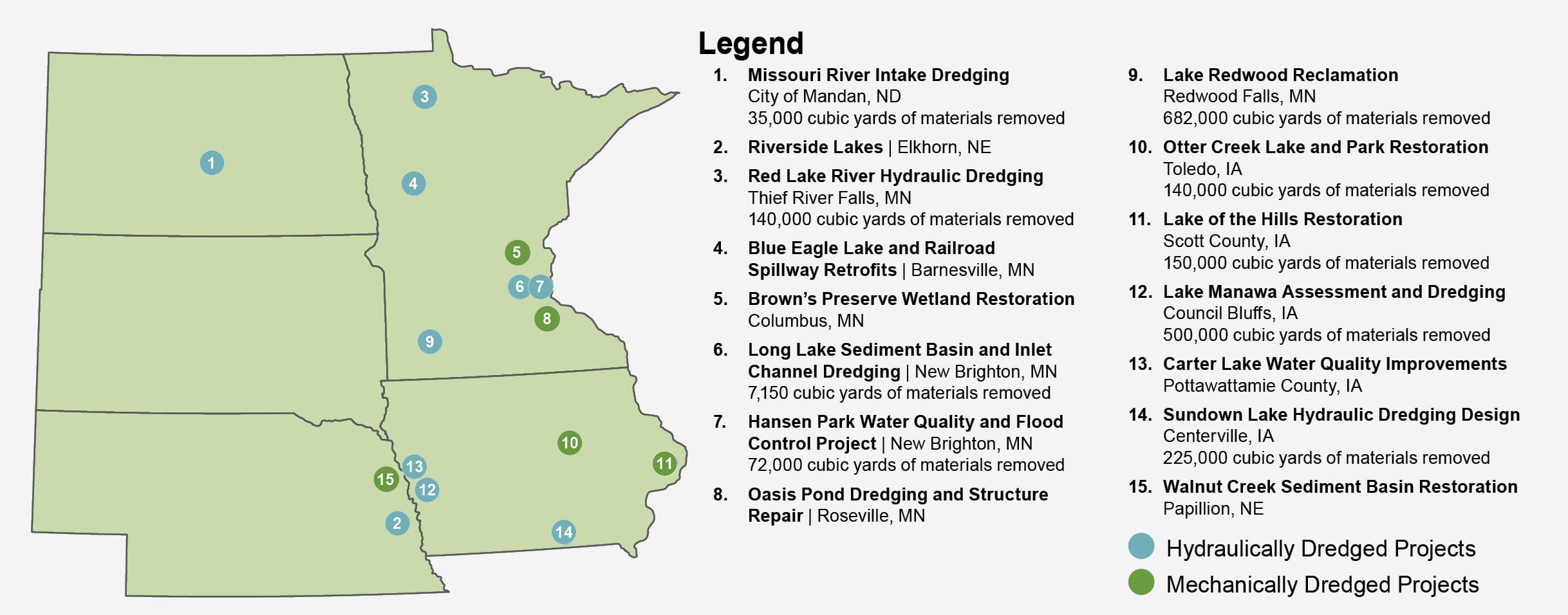
There are two types of dredging, both of which HEI has applied in a variety of projects: mechanical dredging, which uses heavy machinery like excavators to scoop up materials; and hydraulic dredging, which uses large pumps to move a slurry of water and dredge materials through a pipeline.
The key benefits for dredging include increased flood storage, land reclamation, environmental cleanup, infrastructure development, ecological benefits, and recreation opportunities. Dredging can help control flooding by deepening rivers or restoring flood storage capacity in reservoirs. Dredged materials are typically stored in designated spoil sites designed to stabilize and contain sediment. In some cases, it may be possible to use dredged sediments to reclaim or create useful land area adjacent to shore.

Lake Redwood Reclamation, Redwood Falls, Minnesota
Lake Redwood was created in the early 1900s to provide recreational opportunities to the community of Redwood Falls. The lake’s recreational benefits made it a staple for the City and surrounding communities. The City also added a hydroelectric plant to supplement its electrical power supply. By the 1980s, the 65-acre lake was full of accumulated sediment and could no longer support recreational activities.
HEI was engaged by the Redwood Cottonwood Rivers Control Area (RCRCA) to develop a plan to hydraulically dredge the lake and increase the average depth from 2.3 feet to 10 feet, with a maximum depth of 20 feet. HEI also supported the RCRCA with the complicated process to secure permit authorizations from the Minnesota Department of Natural Resources, the US Army Corps of Engineers, Redwood County, the Minnesota Department of Transportation, and others to complete the project.
The project consisted of two phases. During Phase I, HEI designed and supported construction of a confined disposal facility, where the dredged materials were transported via pipeline. After the sediment settled, clean water was returned through a ditch to the Minnesota River. Phase II consisted of the removal of 682,000 cubic yards of accumulated sediment materials via a 3.3-mile pipeline route to the disposal facility.
Dredging Lake Redwood improved the lake’s water quality, which resulted in a higher quality fishery as well as aquatic plant communities. The deeper and cleaner lake also helped increase the hydroelectric plant’s productivity.

View larger map
Walnut Creek Sediment Basin Restoration, Papillion, Nebraska
Years of development have filled the Walnut Creek sediment basin with sediment and nutrients, allowing them to flow into Walnut Creek Lake. Restoring the basin will enable it to trap these materials again, improving water quality downstream. The restoration of the Walnut Creek sediment basin to its initial purpose would again allow for sediment and nutrients to settle out in the basin prior to reaching Walnut Creek Lake.
HEI evaluated current conditions of the basin and developed a design to remove accumulated sediments and provide storage capacity for estimated future sediment loads while still maintaining adequate depths. As part of the project, HEI designed a containment site to place the sediment removed from the basin within the park in a manner that did not disrupt existing uses. The restoration project also included a walkout peninsula, which is incorporated as a water access feature for the adjacent dog park. Construction was successfully completed in the spring of 2024, and the basin is now providing protection to Walnut Creek Lake as originally intended.
Lake of the Hills Restoration, Scott County, Iowa
HEI was hired by the Scott County Conservation Board to complete planning, design, engineering, and permitting services for a variety of projects associated with the restoration of several lakes within West Lake Park (Lake of the Hills, Bluegrass Lake, Railroad Lake, and Lambach Lake). Overarching goals of this project included sediment and nutrient load reductions for water quality improvement, increased lake depth and fish habitat diversity, and improved shorelines to reduce erosion and increase angler access at the West Lake Complex.
Bluegrass Lake, Railroad Lake, and Lamback Lake were designed to be retention ponds and protect Lake of the Hills. Over time, sediment was transported through overland runoff and accumulated in the 50-year-old, man-made lakes.
A major component for this project was the prioritization and design of potential watershed best management practices and in-lake improvements. HEI evaluated multiple dredging locations and techniques, considered sediment handling of each option, and developed a sediment storage site to safely store the dredged materials. A cost-benefit analysis was used to determine which locations and dredging options should be implemented in the final design.
In-lake dredging was completed to remove legacy sediment, improve water quality and fish habitat, and stabilize the shoreline.
What’s Next

In addition to flood prevention, dredging plays a vital role in environmental restoration and water quality management. It helps to remove polluted sediments from waterways, restore habitats, and promote biodiversity, ensuring that critical infrastructure and ecosystems remain resilient for the future.